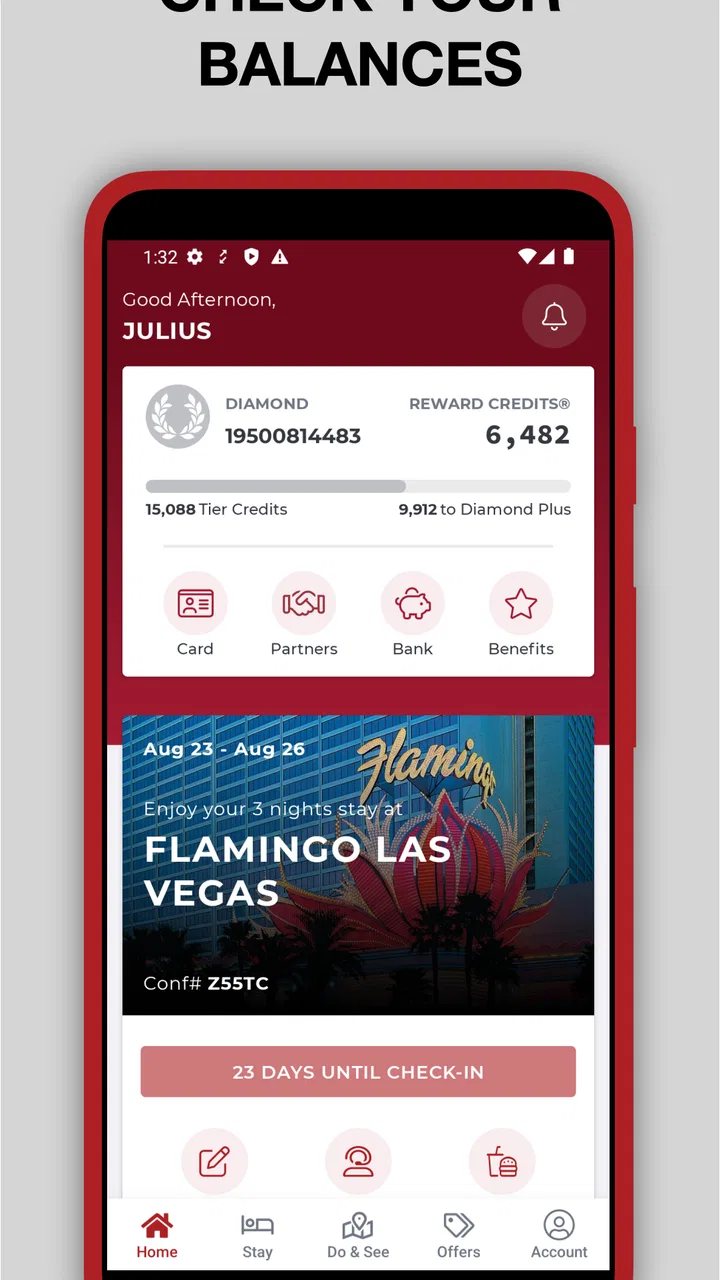
Caesars Rewards Resort Offers
- 4.6
- Rating
- 1.00M
- Installs
- Free
- Price

 Analysis by App-foxy
I approach Caesars Rewards Resort Offers as a practical travel companion rather than a complete trip planner. It is a free Travel & Local app from Caesars Entertainment, built around the company’s resort ecosystem in destinations such as Las Vegas, Atlantic City, and New Orleans. After spending time with it, I found its value depends heavily on one question: are you considering a Caesars property, or are you already part of that resort network? If the answer is yes, the app can make offer discovery and trip preparation more convenient. If not, much of its appeal disappears quickly.
The app has the reach you would expect from a well-established resort brand. It has passed one million installs, carries a 4.6 average from roughly 53 thousand ratings, and has about 8.6 thousand written reviews. Those figures suggest that it is not a niche booking tool used only by a small group of casino visitors. At the same time, popularity should not be confused with universal usefulness. The experience is specialized, and its strongest features make the most sense when your plans already involve Caesars.
How the current app fits into a real trip
My first impression is that the app works best as a decision-making layer between browsing and booking. Instead of treating it like a general hotel marketplace, I would open it when I was comparing a Caesars resort stay, checking whether a particular destination deserves attention, or trying to keep resort-related information in one place. That narrower purpose makes the app easier to understand, but it also means it should sit alongside, not necessarily replace, the other travel tools on your phone.
You May Also Like

 Blood Strike: 2.5 Anniversary
Blood Strike’s Loadouts Turn Every Drop Into a Tactical Gamble
A close look at Blood Strike’s custom loadouts: how fast access to signature weapons reshapes its battle royale rhythm, rewards preparation, and narrows the gap between fights.

 Pandora - Music & Podcasts
Pandora’s Music Is Easy to Start, but Harder to Recover
Pandora’s strength is its low-effort path from a seed to a station. Its weak spot is how much confidence it asks you to place in connection, setup, and quiet recovery.

 8 Ball Pool
 Is Built on Rivalries, Rematches, and Routine
A close look at the rivalries, rematches, shared routines, and unanswered safety questions that turn a quick pool match into a persistent mobile community.

 Samsung Music
’s Quiet Strength Is Playing What You Already Own
Its reach comes less from spectacle than from dependable access to a personal library. That simplicity is both the app’s strongest retention engine and its ceiling.

 AccuWeather: Weather Radar
AccuWeather Review: A Quick, Clear Forecast for Everyday Decisions
For everyday plans, the best forecast is the one you can understand quickly. AccuWeather makes rain timing, radar, and local conditions easy to act on, with a few trade-offs.

 Hill Climb Racing
Why Hill Climb Racing Still Turns Crashes Into One More Run
A tiny car, a bumpy hill and one more upgrade: Hill Climb Racing keeps resurfacing because its simple chaos makes every near-miss feel personal.
More From Our News Desk



For example, imagine planning a long weekend in Las Vegas. I might begin with a broad travel service to compare neighborhoods, flights, and hotels across different brands. Once Caesars properties enter the shortlist, this app becomes more relevant. I can use it to focus on the resort group’s own options and offers rather than sorting through unrelated accommodation listings. That workflow is more efficient than starting inside a brand app when I am still undecided about the city or hotel chain.
The same pattern applies to Atlantic City or New Orleans. The app’s destination coverage gives it a clear identity, but it does not turn it into a universal guide to everything happening in those places. I would still use maps, local event listings, restaurant research, and transport apps for the broader trip. The Caesars experience is most useful for the part of the journey connected to its resorts and rewards relationship.
One practical strength is that a dedicated resort app can reduce the mental switching involved in planning. Instead of repeatedly searching the web for the same brand, I can return to one place when I want to review an offer or revisit a property decision. That is especially helpful when a trip is being planned over several days and the details are easy to lose among browser tabs, email messages, and general booking apps.
There is also a useful distinction between looking for a deal and looking for the right deal. Resort offers may appear attractive at first glance, but I would read the conditions carefully before treating any promotion as a saving. A lower room price may be less important than the dates, the property, the room category, or the way the offer fits the rest of my itinerary. The app can bring the opportunity to my attention; I still need to judge whether it actually improves my trip.
Where it is strongest for existing members
The app feels most natural for people who already interact with Caesars Rewards. For those users, a resort-focused mobile experience can be more useful than a generic hotel site because the decision is not only about room cost. The wider relationship with the brand may influence where to stay, how often to return, and which destination feels convenient. In that situation, the app becomes part of an ongoing travel routine rather than a one-time search tool.
I would particularly recommend it to someone who visits Caesars destinations more than once, keeps an eye on resort offers, or prefers to research directly through the operator. The free price removes an obvious barrier to trying it, although the value still depends on whether the available properties and promotions match your plans. A free app is not automatically worth keeping if it does not serve your travel habits.
For a first-time visitor, the app can still be useful, but I would use it with a comparison mindset. Check the resort option here, then compare the total trip cost and practical location with alternatives elsewhere. A tempting offer may not be the best choice if it creates extra transport time, complicates your schedule, or does not suit the type of trip you want.
What the current version suggests about product maturity
The current version is 9.10.3, which gives the app the feel of an actively maintained product rather than a forgotten companion application. The release history is long too: it first appeared on February 17, 2014. That combination matters because a travel app has to survive changing user expectations, changing resort operations, and the everyday need for dependable access while people are away from home.
I would not interpret a high version number as proof that every part of the experience is perfect. It does, however, suggest a product that has had time to evolve beyond a simple promotional brochure. In practical terms, I expect a mature app to be more useful for repeat visits, offer checking, and brand-specific planning than a newly launched app with a narrow first release.
The minimum operating-system requirement is 10, so anyone using an older device should check compatibility before making the app part of a trip plan. That is a small detail, but it matters more for travel than it might for a casual app. Discovering a compatibility problem while preparing to leave is avoidable friction. On a supported phone, I would still update the app before traveling rather than waiting until I am already at the resort.
How its evolution affects people who already use it
For an existing user, the main benefit of an established app is continuity. A mature resort application is easier to build into a routine: check it during planning, return when a new trip is being considered, and use it as a brand-specific reference point. The exact value of each update may vary, but the broader advantage is having a familiar place to revisit instead of starting the search from scratch every time.
There is a trade-off here. Long-running apps often accumulate more functions and more account-related steps than a simple offer page. That can be helpful when you want a broader resort relationship, but it can also make the experience feel heavier when all you want is a quick look at available accommodation. I would judge it by the task in front of me: for repeated Caesars planning, the extra depth is easier to justify; for a single anonymous hotel search, it is less compelling.
I also think existing users should treat mobile convenience as a supplement to careful trip preparation. I would save important booking details separately, confirm the dates and property before committing, and avoid assuming that an in-app offer automatically covers every part of a stay. Travel plans can involve room rules, resort-specific conditions, and timing details that deserve a deliberate check rather than a quick tap.
Another non-obvious advantage is psychological rather than technical: a dedicated app can help separate inspiration from commitment. I can browse a destination or offer while still deciding, then return later when the trip becomes realistic. That is less chaotic than making a booking immediately from the first attractive result. The downside is that frequent promotional browsing can encourage impulse decisions, so I would set a budget and itinerary first.
Where it falls short compared with broader travel tools
The biggest limitation is its focus. A general travel app is better when I need to compare many hotel groups, inspect a whole city, combine flights and accommodation, or build a multi-stop itinerary. Caesars Rewards Resort Offers is better when the brand itself is already part of the decision. Neither approach is inherently superior; they solve different problems.
I would also avoid using it as my only source of local information. A resort-focused app may help me think about where to stay, but it cannot replace independent research into neighborhoods, walking distances, public transport, weather, dining preferences, or activities outside the property. For a trip built around exploring a city rather than spending time at a resort, a broader planning setup will usually be more balanced.
There is a similar limitation for travelers who want maximum flexibility. If I am looking for a small independent hotel, a vacation rental, or a property with a very different atmosphere, the app’s brand focus is naturally restrictive. In that case, I would use a general accommodation service first and only open this app if a Caesars property becomes a serious option.
The mature design can also create a learning curve for someone who has no interest in rewards programs. A returning member may understand why a dedicated brand app is worthwhile, while a casual traveler may see another account or another travel interface to manage. That is not a defect for the intended audience, but it is a real reason some people should skip the download.
Three smarter ways I would use it
First, I would use it early enough to compare the offer with the whole trip, not at the last minute when a promotional message feels urgent. I would write down the destination, preferred dates, acceptable room type, and total budget before evaluating what appears in the app. This turns the tool into a filter instead of letting the offer define the trip.
Second, I would use it as a repeat-visit shortcut. If I already know that a Caesars property suits my preferred location or style of travel, checking the app before every new booking can be more efficient than beginning with a blank search. The important trade-off is that speed may reduce comparison, so I would still verify whether another property or booking route better fits the itinerary.
Third, I would separate research from final confirmation. I might browse an offer on my phone while commuting, but I would review dates, destination, and conditions again when I have time to concentrate. That simple pause is valuable because travel mistakes are often caused by rushed taps rather than a lack of information.
A fourth useful habit is to keep independent travel details outside the app. I would use a calendar for the full itinerary, a maps application for transport, and a secure note for essential reservation information. This avoids turning one resort app into the single point of failure for an entire trip and makes the plan easier to share with companions.
Who should install it, and who should pass
I would recommend trying it if you are considering Las Vegas, Atlantic City, New Orleans, or another Caesars destination and want a direct way to explore the company’s resort options. It is also a sensible choice for regular Caesars Rewards users who prefer to manage their resort research from a phone. The free download makes testing it relatively straightforward, provided the device meets the operating-system requirement.
I would be less enthusiastic for someone who wants a neutral comparison across every hotel brand. That traveler will probably get more immediate value from a broad booking platform, especially when price, location, and independent reviews matter more than loyalty to one operator. I would also skip it if the trip is centered on a destination’s local life rather than a Caesars resort, because the app’s specialization may add little to that plan.
The mature audience rating of Mature 17+ is another factor families should consider before handing the app to younger travelers. Parents planning a destination trip should make their own decision about whether the app is appropriate for the intended user, rather than assuming that a travel category automatically means family-oriented content.
What I would watch as the app continues to evolve
The most important future question is whether new releases keep improving the balance between promotional discovery and practical trip planning. A resort app earns a permanent place on my phone when it helps me make a better decision, not merely when it gives me more reasons to browse. I would value clearer organization, a calm path from offer discovery to confirmation, and information that helps travelers understand the real fit of a property.
I would also watch how well the experience serves both newcomers and established members. Repeat users need speed and continuity, while first-time visitors need context and transparent choices. If the app can support both without making either group work too hard, its long development history will translate into a meaningful advantage.
My overall view is positive but deliberately specific. Caesars Rewards Resort Offers is most useful when Caesars is already part of your travel decision. It gives me a focused way to explore the brand’s resort possibilities and revisit them over time, while its free access and strong user response make it easy to try. I would not replace my general travel tools with it, and I would never judge an offer without checking the complete itinerary. Used as a focused companion rather than an all-purpose travel planner, it is a worthwhile addition for the right traveler.
With its 4.6 average, more than one million installs, and backing from Caesars Entertainment, Caesars Rewards Resort Offers has clearly found an audience. My recommendation is therefore conditional but clear: install it if you are planning around Caesars properties or regularly use the rewards ecosystem; leave it aside if you need broad, brand-neutral travel comparison. That distinction is what makes the app useful instead of merely familiar.
FAQs for Caesars Rewards Resort Offers
01What is Caesars Rewards Resort Offers?
Caesars Rewards Resort Offers is a mobile experience for eligible Caesars Rewards members to view and access personalized promotions from participating Caesars Entertainment resorts. Depending on your account and current campaigns, offers may include discounted or complimentary hotel stays, dining credits, entertainment, casino-related benefits, or other resort perks. Available deals can vary by location, membership level, dates, and eligibility.
02Do I need a Caesars Rewards account to use the app?
Yes, most personalized resort offers require you to sign in with an active Caesars Rewards account. After logging in, the app can display promotions associated with your membership profile, play history, location, and other eligibility factors. If you do not yet have an account, you may need to register through Caesars before accessing member-only offers. Some public resort information may be visible without signing in.
03Are the resort offers completely free?
Not necessarily. An offer described as complimentary may still include taxes, resort fees, service charges, deposits, or other restrictions. Certain promotions also require a minimum stay, specific booking dates, qualifying casino activity, or payment for additional guests and services. Before confirming a reservation, carefully review the complete terms, blackout dates, expiration date, and any charges shown during checkout.
04Can I use these offers at any Caesars resort?
Offers are generally limited to the properties, destinations, and dates listed in the individual promotion. Availability may differ between resorts, and an offer shown in the app may not be transferable to another location. Some deals are valid only for selected room types, events, restaurants, or experiences. Always open the offer details and confirm the participating property before making travel arrangements.
05What should I do if an offer is missing or will not apply?
First, check that you are signed in to the correct Caesars Rewards account and that the promotion has not expired. Review its eligibility requirements, booking window, minimum stay, and property restrictions, since an apparently suitable reservation may still fail to qualify. Updating the app or signing out and back in can help. If the problem continues, contact Caesars Rewards or the resort directly.
Pros
- Exclusive hotel
- dining
- and entertainment offers for members.
- Easy access to Caesars Rewards account details and tier status.
- Useful for comparing resort deals across multiple destinations.
- Mobile booking can simplify planning eligible Caesars stays.
- Rewards activity and available benefits are collected in one place.
Cons
- Some offers require specific dates
- properties
- or minimum stays.
- Prices may change before checkout
- limiting deal availability.
- Best benefits often depend on earning a higher rewards tier.
- The app may request location or notification permissions.
- Offer terms can be lengthy and vary between participating resorts.

Caesars Rewards Resort Offers
Gallery